
 Nextcloud Desktop ClientLinux
vs
SyncthingWindows
Nextcloud Desktop Client como alternativa Linux ao Syncthing
Atualizado em
Nossa avaliação
Nextcloud Desktop Client can replace Syncthing for users who are comfortable with a central server (self‑hosted or hosted) and need integration with Nextcloud's sharing and versioning features. It works well for typical desktop sync scenarios, but it does not provide true peer‑to‑peer syncing, so teams that rely on direct device‑to‑device transfers without a server will miss that capability.
- Licença
- GPL-2.0+
- Preço
- Grátis
- Versão mais recente
- 35.0.3 (5 de novembro de 2026)
- Avaliação
- —
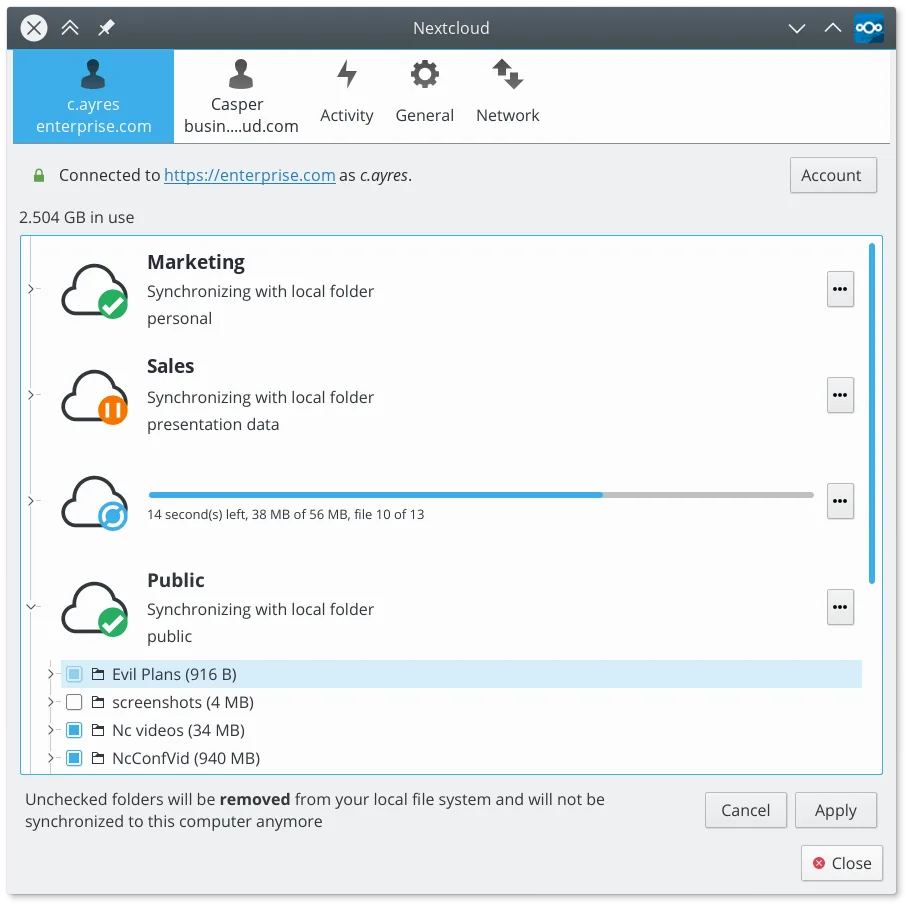
O que funciona igual
- Two‑way file synchronization
- Automatic detection of changes in local folders
- Cross‑platform clients (Linux desktop, Windows, macOS, mobile)
- Encrypted transfer of data
- Support for large files and high‑volume sync
O que muda
- Syncthing is pure peer‑to‑peer; Nextcloud requires a server as an intermediary
- Nextcloud offers built‑in sharing, versioning and collaboration tools; Syncthing does not
- Syncthing provides a web UI for configuration; Nextcloud uses a desktop UI and server web UI
- Device discovery in Syncthing is automatic via local network/Internet; Nextcloud needs manual addition of devices on the server
- Nextcloud can store files centrally for backup; Syncthing keeps only copies on the participating devices
Abrindo seus arquivos do Syncthing
Both tools store files in the native filesystem, so any files synced with Syncthing can be opened directly after copying them to a Nextcloud‑synced folder. No special export step is required; just ensure the files are placed in a folder that the Nextcloud client monitors.
Trocando o Syncthing pelo Nextcloud Desktop Client, passo a passo
- Install the Nextcloud Desktop Client from your distro's repository or Flathub.
- Set up or point to an existing Nextcloud server (self‑hosted or a hosted instance).
- Create a sync folder in the client and point it to the directory currently used by Syncthing.
- Stop the Syncthing service and let Nextcloud perform the initial upload of existing files.
- Verify that changes on the Linux machine appear on the server and on any other devices.
- Add any additional devices (Windows, macOS, mobile) to the same Nextcloud account.
Principais recursos do Nextcloud Desktop Client
- Sincronização bidirecional de arquivos entre pastas locais e o servidor
- Suporte a controle de versão de arquivos e recuperação de arquivos excluídos
- Integração com o servidor Nextcloud para compartilhamento e colaboração
- Disponível como Flatpak e pacotes nativos para as principais distribuições
- Funciona com qualquer backend compatível com Nextcloud, incluindo instâncias autohospedadas
- Operação em segundo plano com uso mínimo de recursos
- Suporte a arquivos grandes e operações intensas de sincronização
Como instalar o Nextcloud Desktop Client no Linux
flatpak install flathub com.nextcloud.desktopclient.nextcloudsudo apt install nextcloud-desktopsudo apt install nextcloud-desktopsudo dnf install nextcloud-clientsudo pacman -S nextcloud-clientsudo zypper install nextcloud-desktopPerguntas frequentes
Can I keep using Syncthing on some devices while using Nextcloud on others?
Yes, but you will end up with two separate sync ecosystems; files changed by one will not automatically appear in the other unless you manually copy them.
Do I need to run a Nextcloud server to use the desktop client?
A server is required. You can install Nextcloud on a spare machine, a VPS, or use a hosted provider.
Is the data still end‑to‑end encrypted like with Syncthing?
The client encrypts traffic (HTTPS/TLS) to the server, but encryption is not end‑to‑end; the server can read the files.
Outras 2 alternativas ao Syncthing
 Seafile ClientO Seafile é um cliente de sincronização de arquivos multiplataforma que mantém pastas locais sincronizadas…Código abertoGrátisFlatpakSeafile Client vs Syncthing
 Syncthing TrayA system tray icon and menu for Syncthing that adds status indicators, notifications, and quick actions to…Código abertoGrátisFlatpakSyncthing Tray vs Syncthing