
 geditLinux
vs
EmacsWindows
gedit als Linux-Alternative zu Emacs
Aktualisiert am
Unser Fazit
gedit is not a realistic replacement for Emacs if you rely on its extensibility, modal editing, or Lisp customization. It is a simple, modal-free text editor designed for general-purpose use and basic coding. It lacks the deep integration, terminal access, and plugin ecosystem that define the Emacs experience. Switching to gedit means abandoning the 'editor within an editor' workflow. It is only suitable for users who want to move away from Emacs entirely because they find it too complex, not for those seeking an equivalent tool.
- Lizenz
- GPL-2.0+
- Preis
- Kostenlos
- Aktuelle Version
- 51.0 (15. Oktober 2026)
- Bewertung
- 5/5 (1)
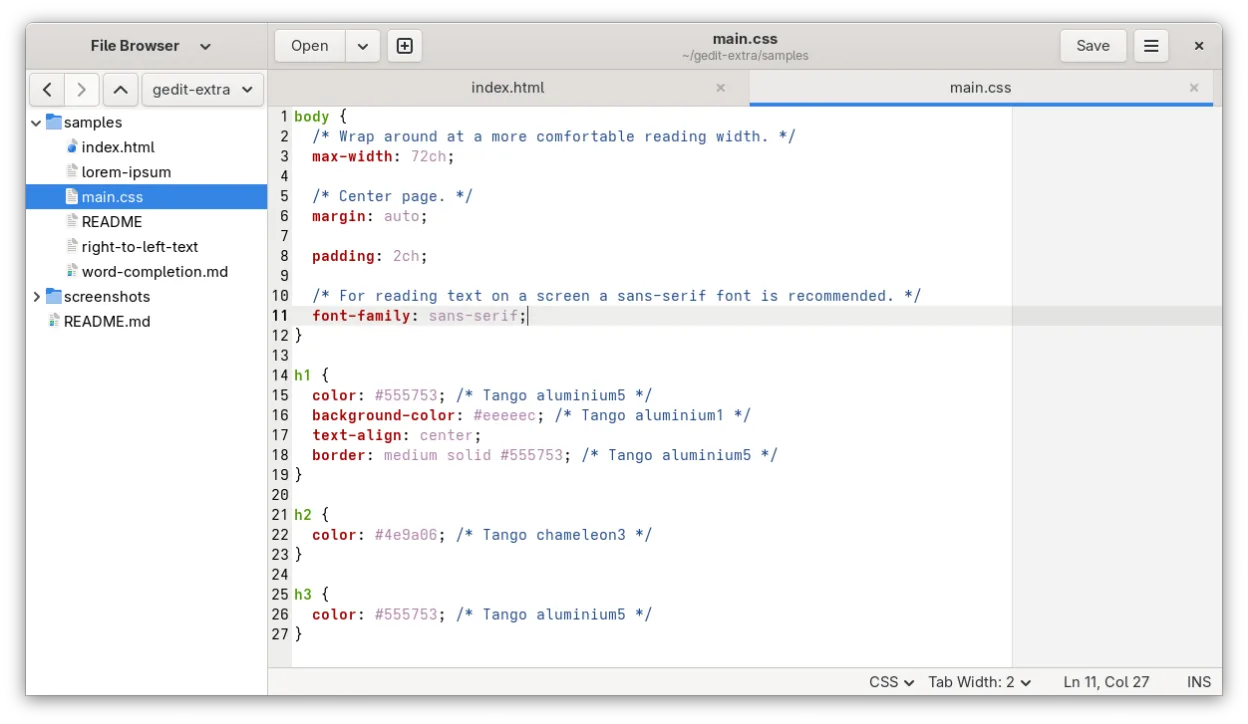
Was gleich funktioniert
- Supports syntax highlighting for many programming languages
- Allows customization of keybindings and editor settings
- Handles UTF-8 text encoding and multiple document interfaces
- Provides basic search and replace functionality
Was anders ist
- No native modal editing mode or Lisp-based customization system
- Lacks integrated terminal or shell access within the editor
- Limited plugin ecosystem compared to Emacs packages
- No built-in remote file editing capabilities like Tramp
- No native version control integration or advanced IDE features
Ihre Emacs-Dateien öffnen
gedit opens and saves standard plain text files (.txt, .c, .py, .js, etc.) without issue. If you use Emacs-specific file formats like .org or .el, gedit will open them as plain text but will not render Org-mode structures or provide Lisp evaluation. There is no special conversion needed for plain text, but you lose the semantic structure of Org files.
Von Emacs zu gedit wechseln – Schritt für Schritt
- Install gedit via your package manager or Flathub
- Configure syntax highlighting for your primary languages
- Set up custom keybindings to match your muscle memory
- Enable line numbers and auto-indent for code editing
- Install necessary plugins for basic enhancements
- Test opening existing text files to ensure compatibility
Wichtige Funktionen von gedit
- Syntax‑Highlighting für viele Programmiersprachen
- Plugin‑System zur Erweiterung der Funktionalität
- Suchen und Ersetzen mit Regex‑Unterstützung
- Konfigurierbare Schrift, Tab‑Breite und Zeilenumbruch
- Zeilennummern, Klammerabgleich und Auto‑Einrücken
- UTF‑8‑Textkodierungsunterstützung
- Drag‑and‑Drop‑Textbearbeitung
- Mehrfach‑Dokumenten‑Interface mit Tabs
gedit unter Linux installieren
flatpak install flathub org.gnome.geditsudo apt install geditsudo apt install geditsudo dnf install geditsudo pacman -S geditsudo zypper install geditHäufige Fragen
Can I use Emacs Lisp in gedit?
No. gedit does not support Emacs Lisp or any Lisp-based customization. You cannot run Elisp code or use Emacs packages.
Does gedit have a built-in terminal?
No. gedit does not include an integrated terminal. You must use a separate terminal emulator for shell access.
Is gedit suitable for large codebases?
It is not optimized for large codebases. It lacks features like project-wide search, refactoring tools, and advanced navigation that are common in IDEs or Emacs.
5 weitere Alternativen zu Emacs
 VimVim ist ein hochgradig konfigurierbarer, modaler Texteditor für effizientes Bearbeiten unter Linux.Open SourceKostenlosFlatpakVim vs. Emacs
 NeovimNeovim ist ein moderner Vim‑Fork, der Erweiterbarkeit, fortschrittliche UI‑Unterstützung und leistungsstarke…Open SourceKostenlosFlatpakNeovim vs. Emacs
 KateKate ist ein funktionsreicher, auf Programmierer ausgerichteter Texteditor von KDE mit Unterstützung für über…Open SourceKostenlosFlatpakKate vs. Emacs
 Visual Studio CodeEin leichter, erweiterbarer Code-Editor, der Debugging, Git und viele Sprachen unterstützt.KostenlosFlatpakVisual Studio Code vs. Emacs
 Sublime TextSublime Text ist ein leichter, schneller Quellcode‑Editor mit einer minimalistischen Oberfläche und…FlatpakSublime Text vs. Emacs