
 CherryTreeLinux
vs
Google KeepWindows
CherryTree como alternativa Linux ao Google Keep
Atualizado em
Nossa avaliação
CherryTree is a solid replacement for Google Keep if you prioritize local control, rich content, and structured organization over cloud sync and collaboration. It excels at storing formatted notes, code snippets, images, and links in a hierarchical tree, making it ideal for personal knowledge management. However, it lacks built-in end-to-end encryption, real-time sharing, and mobile access. You’ll need third-party tools for cross-device sync. If you value privacy and deep note formatting over instant collaboration and mobility, CherryTree is a strong choice.
- Licença
- GPL-3.0+
- Preço
- Grátis
- Versão mais recente
- b'1.7.2' (11 de novembro de 2011)
- Avaliação
- —
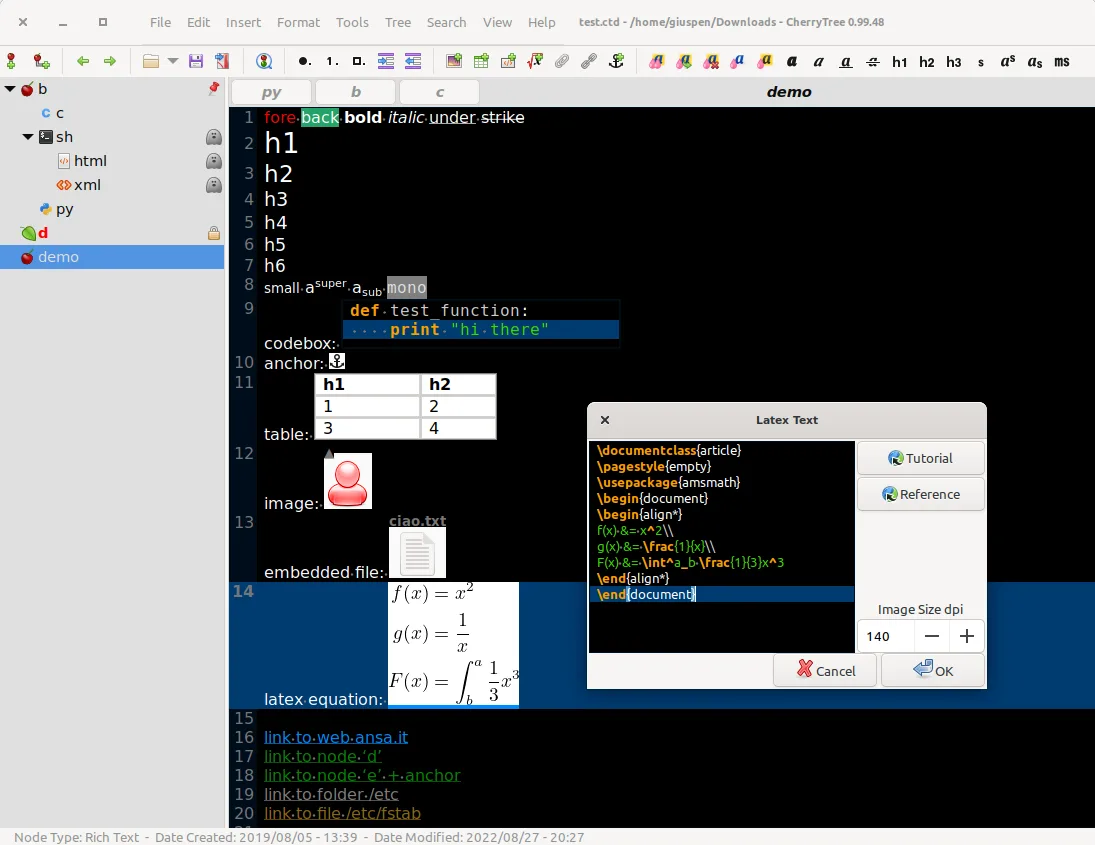
O que funciona igual
- Supports text notes with formatting and to-do lists
- Allows tagging and color-coding of notes via node placement and labels
- Enables image attachment and basic organization
- Lets you set reminders indirectly via pinned nodes or text labels
- Includes search and find/replace functionality
O que muda
- No built-in sync or cloud integration — you must manage sync manually
- No native mobile apps; access on mobile requires workarounds
- No real-time collaboration or sharing features
- No OCR for text extraction from images
- Hierarchical tree structure replaces flat note list, changing workflow
Abrindo seus arquivos do Google Keep
There is no direct way to import Google Keep notes into CherryTree, as Google Keep does not export in standard note formats. You can export Keep notes as text or HTML via Google Takeout, but these must be manually copied or scripted into CherryTree. No automated tools reliably convert Keep data to CherryTree’s format. Migration requires exporting notes from Google’s ecosystem and pasting them into the appropriate nodes.
Trocando o Google Keep pelo CherryTree, passo a passo
- Export your Google Keep notes using Google Takeout
- Convert exported HTML or text files into a readable format
- Launch CherryTree and create a new document
- Manually create parent nodes for categories or labels
- Copy and paste note contents into appropriate nodes
- Use formatting tools to replicate lists, images, and links
Principais recursos do CherryTree
- Anotações hierárquicas em estrutura de árvore
- Texto formatado com imagens, tabelas e listas
- Destaque de sintaxe para blocos de código
- Proteção por senha em nós
- Exportação para PDF, HTML e texto puro
- Importação de outros aplicativos de anotações
- Verificação ortográfica e ferramentas de localizar/substituir
- Armazenamento de dados em XML ou SQLite
Como instalar o CherryTree no Linux
flatpak install flathub net.giuspen.cherrytreesudo apt install cherrytreesudo apt install cherrytreesudo pacman -S cherrytreesudo zypper install cherrytreePerguntas frequentes
Can I sync CherryTree across devices like Google Keep?
Not natively. You can sync the data file using third-party services like Syncthing or Nextcloud, but ensure only one instance is open at a time to avoid corruption.
Is there a mobile version of CherryTree?
No. You can view or edit the file on mobile using a text or code editor if synced, but full functionality requires the desktop app.
Can CherryTree extract text from images like Google Keep?
No. CherryTree stores images but doesn’t include OCR. You’d need external tools like Tesseract to extract text and manually add it.
Outras 5 alternativas ao Google Keep
 JoplinJoplin é um aplicativo de anotações e tarefas de código aberto e multiplataforma que armazena dados em…Código abertoGrátisFlatpakJoplin vs Google Keep
 Standard NotesO Standard Notes é um aplicativo de anotações com criptografia de ponta a ponta que funciona em várias…Código abertoGrátisFlatpakStandard Notes vs Google Keep
 ZimZim is a desktop wiki for taking and organizing notes in plain text files.Código abertoGrátisFlatpakZim vs Google Keep
 ObsidianO Obsidian é um aplicativo de base de conhecimento baseado em markdown que armazena notas como arquivos de…FlatpakObsidian vs Google KeepNotejotNotejot is a lightweight KDE sticky note application that pins notes to your desktop for quick reminders.Código abertoGrátisNotejot vs Google Keep