
 geditLinux
vs
EmacsWindows
gedit como alternativa Linux a Emacs
Actualizado el
Nuestra opinión
gedit is not a realistic replacement for Emacs if you rely on its extensibility, modal editing, or Lisp customization. It is a simple, modal-free text editor designed for general-purpose use and basic coding. It lacks the deep integration, terminal access, and plugin ecosystem that define the Emacs experience. Switching to gedit means abandoning the 'editor within an editor' workflow. It is only suitable for users who want to move away from Emacs entirely because they find it too complex, not for those seeking an equivalent tool.
- Licencia
- GPL-2.0+
- Precio
- Gratis
- Última versión
- 51.0 (15 de octubre de 2026)
- Valoración
- 5/5 (1)
Lo que funciona igual
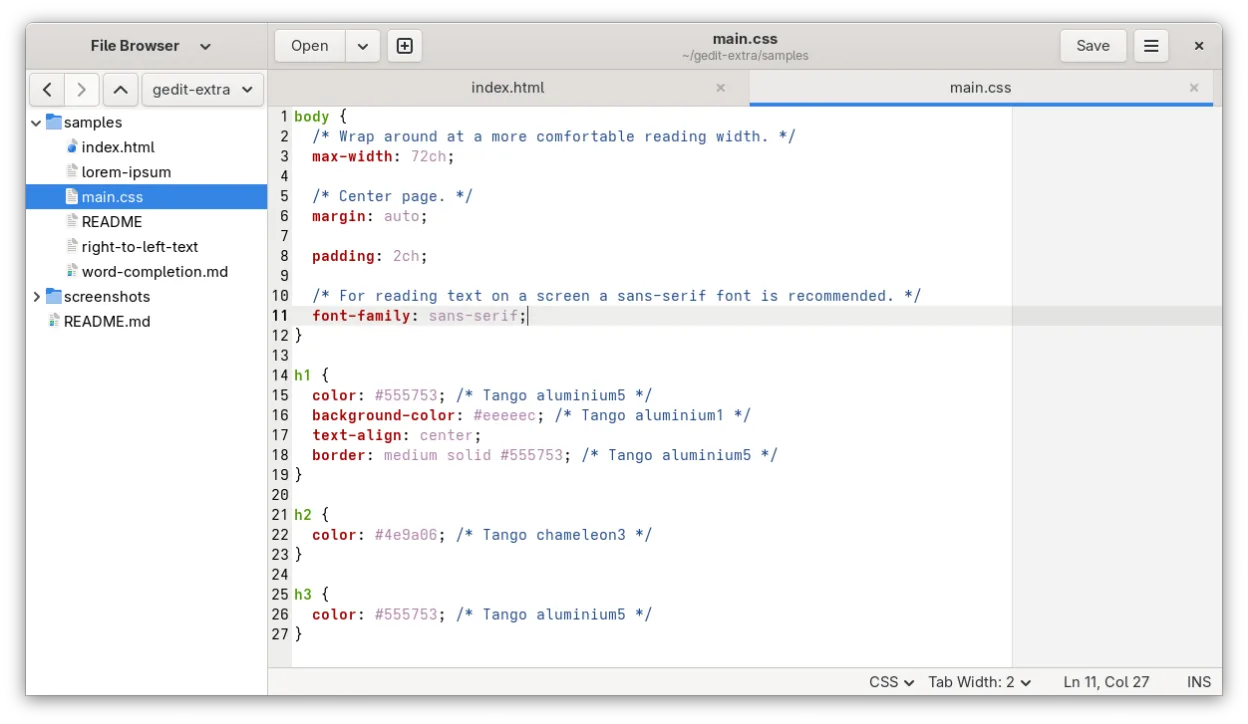
- Supports syntax highlighting for many programming languages
- Allows customization of keybindings and editor settings
- Handles UTF-8 text encoding and multiple document interfaces
- Provides basic search and replace functionality
Lo que cambia
- No native modal editing mode or Lisp-based customization system
- Lacks integrated terminal or shell access within the editor
- Limited plugin ecosystem compared to Emacs packages
- No built-in remote file editing capabilities like Tramp
- No native version control integration or advanced IDE features
Abrir tus archivos de Emacs
gedit opens and saves standard plain text files (.txt, .c, .py, .js, etc.) without issue. If you use Emacs-specific file formats like .org or .el, gedit will open them as plain text but will not render Org-mode structures or provide Lisp evaluation. There is no special conversion needed for plain text, but you lose the semantic structure of Org files.
Pasar de Emacs a gedit, paso a paso
- Install gedit via your package manager or Flathub
- Configure syntax highlighting for your primary languages
- Set up custom keybindings to match your muscle memory
- Enable line numbers and auto-indent for code editing
- Install necessary plugins for basic enhancements
- Test opening existing text files to ensure compatibility
Funciones clave de gedit
- Resaltado de sintaxis para muchos lenguajes de programación
- Sistema de complementos para ampliar funcionalidad
- Búsqueda y reemplazo con soporte de expresiones regulares
- Fuente, ancho de tabulación y ajuste de línea configurables
- Números de línea, coincidencia de corchetes y sangría automática
- Soporte de codificación UTF-8
- Edición de texto con arrastrar y soltar
- Interfaz de documento múltiple con pestañas
Cómo instalar gedit en Linux
flatpak install flathub org.gnome.geditsudo apt install geditsudo apt install geditsudo dnf install geditsudo pacman -S geditsudo zypper install geditPreguntas frecuentes
Can I use Emacs Lisp in gedit?
No. gedit does not support Emacs Lisp or any Lisp-based customization. You cannot run Elisp code or use Emacs packages.
Does gedit have a built-in terminal?
No. gedit does not include an integrated terminal. You must use a separate terminal emulator for shell access.
Is gedit suitable for large codebases?
It is not optimized for large codebases. It lacks features like project-wide search, refactoring tools, and advanced navigation that are common in IDEs or Emacs.
Otras 5 alternativas a Emacs
 VimVim es un editor de texto modal altamente configurable para edición eficiente en Linux.Código abiertoGratisFlatpakVim vs Emacs
 NeovimNeovim es un fork moderno de Vim que añade extensibilidad, soporte avanzado para interfaces de usuario y…Código abiertoGratisFlatpakNeovim vs Emacs
 KateKate es un editor de texto con muchas funciones, orientado a programadores, de KDE, con soporte para más de…Código abiertoGratisFlatpakKate vs Emacs
 Visual Studio CodeUn editor de código ligero y extensible que admite depuración, Git y muchos lenguajes.GratisFlatpakVisual Studio Code vs Emacs
 Sublime TextSublime Text es un editor de código fuente ligero y rápido con una interfaz mínima y una extensibilidad…FlatpakSublime Text vs Emacs