
 BraseroLinux
vs
UltraISOWindows
Brasero como alternativa Linux ao UltraISO
Atualizado em
Nossa avaliação
Brasero is a solid replacement for the burning and creating aspects of UltraISO, but it is not a direct functional match. It handles standard data and audio CD/DVD creation, copying, and multisession burning well within the GNOME environment. However, it lacks the deep ISO editing and conversion tools that define UltraISO. If your workflow is primarily burning files to discs or creating basic ISOs from folders, Brasero works fine. If you rely on modifying existing ISO contents or converting between obscure formats, you will need a different tool.
- Licença
- GPL-2.0-or-later
- Preço
- Grátis
- Versão mais recente
- 3.12.4 (28 de setembro de 2026)
- Avaliação
- —
O que funciona igual
- Creates ISO images from selected files and folders
- Burns ISO images to CD, DVD, or USB media
- Supports ISO 9660 and Joliet extensions for compatibility
- Handles multisession disc creation
- Free and open-source software with no licensing costs
O que muda
- No built-in tool to edit or modify the contents of an existing ISO file
- Lacks conversion features for formats like IMG, BIN, or NRG
- Interface is minimal and GNOME-specific, less feature-dense than UltraISO
- Does not support advanced UDF features beyond basic compatibility
- No command-line interface for automated scripting workflows
Abrindo seus arquivos do UltraISO
Brasero can burn standard .iso files created by UltraISO without issues, as it adheres to standard ISO 9660 and Joliet specifications. It can also create new ISOs that are readable by Windows systems. However, Brasero cannot open proprietary or non-standard disk images (like .bin/.cue pairs or .nrg) for editing or conversion. If you have an UltraISO-created ISO, you can burn it directly. If you need to edit that ISO, Brasero cannot do it; you would need to extract the contents, modify them, and recreate the ISO.
Trocando o UltraISO pelo Brasero, passo a passo
- Install Brasero using your distribution's package manager or Flathub
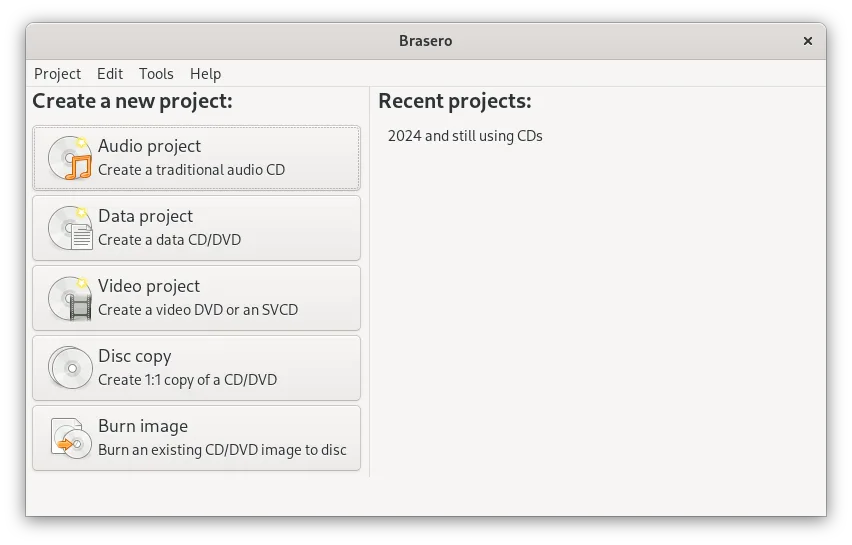
- Use the 'Create Data Disc' option to build new ISOs from folders
- Use the 'Burn Image' option to write existing ISO files to media
- For editing existing ISOs, extract contents with a tool like 7z or archive managers
- Recreate the modified ISO using Brasero's data disc creation feature
- Verify the new ISO on Windows or Linux to ensure compatibility
Principais recursos do Brasero
- Gravar CDs e DVDs de dados
- Criar CDs de áudio
- Copiar CDs e DVDs existentes
- Suporte a CD-TEXT
- Suporte a discos multisessão
- Suporte a extensão Joliet
- Gravação de arquivos via arrastar e soltar
- Integração com o desktop GNOME
Como instalar o Brasero no Linux
flatpak install flathub org.gnome.Braserosudo apt install braserosudo apt install braserosudo dnf install braserosudo pacman -S braserosudo zypper install braseroPerguntas frequentes
Can I edit an existing ISO file in Brasero?
No. Brasero can burn ISOs but cannot open them to add, remove, or modify files inside. You must extract the ISO, make changes, and create a new ISO.
Does Brasero support USB bootable drives?
Yes, it can burn ISO images to USB drives, making them bootable if the ISO is a bootable image. It handles the writing process similarly to CD/DVDs.
Is Brasero available on all Linux distributions?
Yes, it is packaged in major distributions including Ubuntu, Fedora, Debian, and Arch. It is also available via Flathub for easier installation and updates.
Outras 5 alternativas ao UltraISO
 K3bK3b é a ferramenta completa do KDE para gravação de CD/DVD/Blu‑ray no Linux.Código abertoGrátisK3b vs UltraISOXfburnXfburn is a lightweight, GTK+ CD/DVD/BD burning application for Linux.Código abertoGrátisXfburn vs UltraISOISO MasterA lightweight GTK-based GUI for creating, editing, and converting ISO images, available in Fedora…Código abertoGrátisISO Master vs UltraISOGNOME Disk UtilityGNOME Disk Utility is a native Linux tool for managing disks, partitions, and creating ISO images.Código abertoGrátisGNOME Disk Utility vs UltraISO
 AcetoneISOAcetoneISO é uma ferramenta Linux gratuita e de código aberto para montar e gerenciar arquivos de imagem…Código abertoGrátisAcetoneISO vs UltraISO