
 EvolutionLinux
vs
Mozilla ThunderbirdWindows
Evolution como alternativa Linux ao Mozilla Thunderbird
Atualizado em
Nossa avaliação
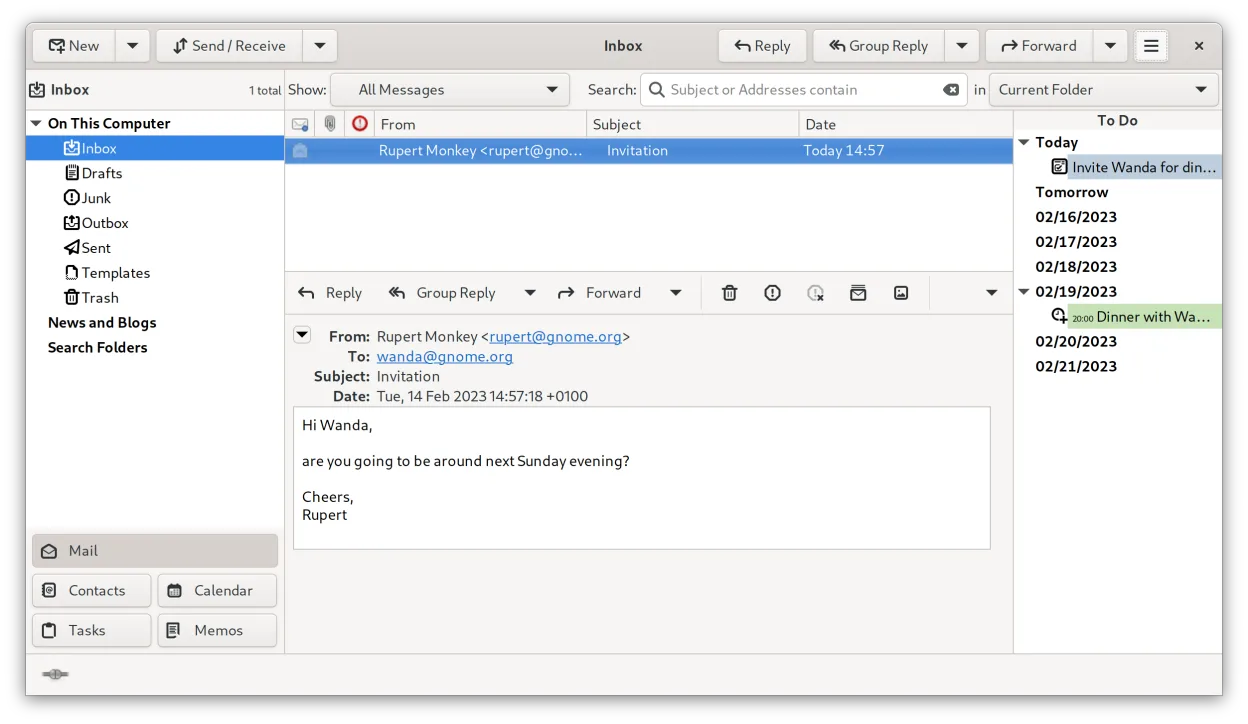
Evolution can replace Thunderbird for users who want a single application that handles mail, calendar, contacts and tasks. It supports IMAP, POP3, SMTP, CalDAV, and Exchange via EWS, and offers built‑in encryption, LDAP integration and advanced filtering. Users who rely heavily on Thunderbird extensions or prefer a lightweight, separate mail client may find Evolution heavier. For most desktop users, Evolution covers the core functions of Thunderbird with added calendar and address‑book integration.
- Licença
- GPL-2.0+ and GFDL-1.3
- Preço
- Grátis
- Versão mais recente
- 3.62.1 (9 de outubro de 2026)
- Avaliação
- —
O que funciona igual
- Both support IMAP, POP3, SMTP, and calendar via CalDAV
- Both can store messages locally and sync folders
- Both offer search, filtering rules and support for multiple accounts
- Both can be extended (Evolution via plugins, Thunderbird via add‑ons)
- Both use standard MIME, iCalendar, vCard formats
O que muda
- Evolution combines mail, calendar, contacts and tasks in one window; Thunderbird separates them into distinct apps
- Thunderbird has a larger ecosystem of extensions; Evolution’s plugin set is smaller
- Thunderbird’s UI is more lightweight; Evolution is heavier and more feature‑rich
- Evolution includes built‑in GnuPG and S/MIME support; Thunderbird requires add‑ons for some encryption features
- Thunderbird’s RSS reader is built‑in; Evolution lacks a dedicated RSS feed reader
Abrindo seus arquivos do Mozilla Thunderbird
Thunderbird stores mail in mbox or maildir format, which Evolution can read if the folders are placed in the correct location. Contacts are stored in .vcf files, which Evolution can import. Calendar data is in .ics files; Evolution can import those. Exporting from Evolution to Thunderbird is possible by exporting mail to mbox, contacts to vCard, and calendars to iCalendar, but the process requires manual file handling.
Trocando o Mozilla Thunderbird pelo Evolution, passo a passo
- Export Thunderbird mail folders to mbox files via File → Export → Mbox
- Copy the exported mbox files into Evolution’s mail folder structure (e.g., ~/.local/share/evolution/mail)
- Export Thunderbird contacts to .vcf using Address Book → Export
- Import the .vcf file into Evolution’s address book via File → Import → vCard
- Export Thunderbird calendar events to .ics via Calendar → Export
- Import the .ics file into Evolution’s calendar via File → Import → iCalendar
Principais recursos do Evolution
- E-mail, calendário, contatos e tarefas integrados em uma única janela
- Suporte completo para IMAP, POP3, SMTP, CalDAV e EWS
- Formatos de dados padrão (MIME, iCalendar, vCard)
- Criptografia integrada com GnuPG e S/MIME
- Livro de endereços com LDAP e armazenamento local
- Compartilhamento de calendário e agendamento via CalDAV
- Regras de filtragem de e-mail e busca
- Atalhos de teclado personalizáveis
Como instalar o Evolution no Linux
flatpak install flathub org.gnome.Evolutionsudo apt install evolutionsudo apt install evolutionsudo dnf install evolutionsudo pacman -S evolution-spamassassinsudo zypper install evolutionPerguntas frequentes
Does Evolution support Thunderbird add‑ons?
No. Evolution has its own plugin system and cannot run Thunderbird extensions.
Can I use Evolution with a Microsoft Exchange account?
Yes, through the EWS extension, which is included in the standard package.
Is Evolution lighter than Thunderbird?
No, Evolution is a full personal information manager and tends to consume more resources than Thunderbird’s lightweight mail‑only design.
Outras 5 alternativas ao Mozilla Thunderbird
 KMailO KMail é o cliente de e-mail completo do KDE, parte da suíte Kontact, com suporte a IMAP, POP3 e caixas…Código abertoGrátisKMail vs Mozilla Thunderbird
 GearyO Geary é um cliente de e-mail baseado no GNOME para Linux que permite enviar, receber e organizar e-mails em…Código abertoGrátisFlatpakGeary vs Mozilla Thunderbird
 MailspringUm cliente de e‑mail desktop rápido e cheio de recursos para Linux com um motor de sincronização em C++ e…Código abertoGrátisFlatpakMailspring vs Mozilla Thunderbird
 Claws MailClaws Mail é um cliente de e‑mail leve e rápido baseado em GTK para Linux.Código abertoGrátisFlatpakClaws Mail vs Mozilla Thunderbird
 Proton MailProton Mail é um cliente de e‑mail gratuito, criptografado de ponta a ponta, para Linux, disponível como…Código abertoGrátisFlatpakProton Mail vs Mozilla Thunderbird