
 MeshLabLinux
vs
3D BuilderWindows
MeshLab como alternativa Linux ao 3D Builder
Atualizado em
Nossa avaliação
MeshLab is a solid replacement for 3D Builder if you're comfortable with a more technical interface. It handles STL, OBJ, and PLY import/export reliably and excels at repairing non-manifold geometry and cleaning up scanned meshes. While it lacks built-in slicing, it prepares models well for 3D printing. The UI is less intuitive than 3D Builder’s, so beginners may struggle. However, for users who prioritize mesh repair and manual control over simplicity, MeshLab is a capable, no-cost Linux alternative.
- Licença
- GPL-3.0-only
- Preço
- Grátis
- Versão mais recente
- 2025.07 (22 de julho de 2025)
- Avaliação
- —
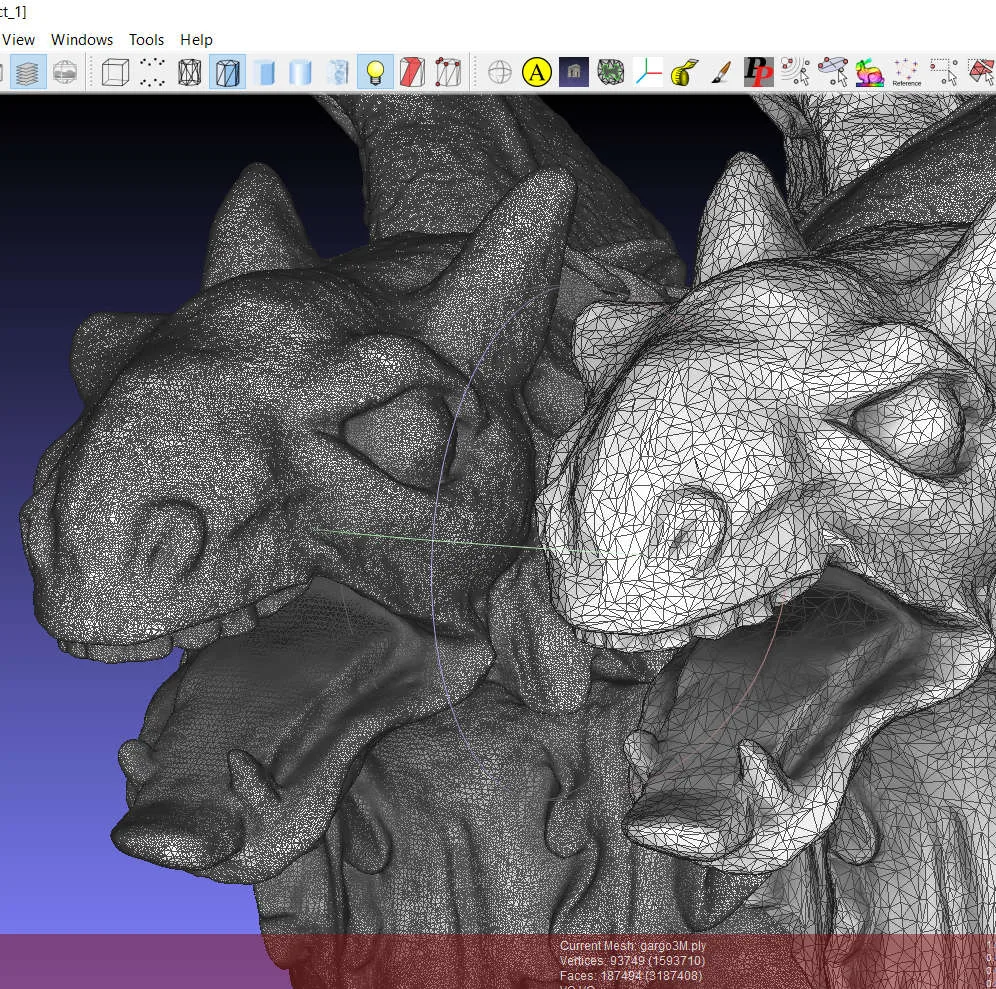
O que funciona igual
- Supports import and export of STL, OBJ, and PLY formats
- Allows basic transformations like scale, rotate, and translate
- Can combine multiple meshes into a single model
- Offers wireframe and solid viewing modes
- Includes tools for 3D printing preparation, such as checking mesh integrity
O que muda
- MeshLab has no built-in slicer; slicing must be done in a separate program
- UI is more complex and less beginner-friendly than 3D Builder
- No direct integration with 3D printer firmware or preview
- Lacks simple, guided workflows for common tasks
- Advanced features like scripting and batch processing go beyond 3D Builder’s scope
Abrindo seus arquivos do 3D Builder
MeshLab reads and writes STL, OBJ, and PLY files directly, matching the formats used by 3D Builder. You can open models saved from 3D Builder without issues, and export them in formats ready for 3D printing. MeshLab also supports other mesh formats like OFF and X3D, increasing flexibility. While it doesn’t export to proprietary printer formats, standard STL output works with all common slicing tools.
Trocando o 3D Builder pelo MeshLab, passo a passo
- Install MeshLab via your package manager or Flathub: 'flatpak install flathub org.meshlab.MeshLab'
- Open your 3D Builder-exported STL or OBJ file using File > Import
- Use Filters > Cleaning and Repairing to fix non-manifold edges, holes, or flipped normals
- Apply transforms under Filters > Transform with scale, rotate, or translate as needed
- Combine meshes using Filters > Sampling > Merge Visible Layers if required
- Export the final model via File > Export Mesh for use in your slicer
Principais recursos do MeshLab
- Ferramentas de limpeza e reparo de malha para corrigir geometria quebrada
- Algoritmos de redução e simplificação de polígonos
- Capacidades de mapeamento de textura e desembrulho UV
- Suporte para preparação e análise de impressão 3D
- Processamento de dados brutos de dispositivos de digitalização 3D
- Renderização e visualização de modelos 3D
- Conversão entre vários formatos de arquivo 3D
- Suporte a scripts para processamento em lote
Como instalar o MeshLab no Linux
flatpak install flathub net.meshlab.MeshLabsudo apt install meshlabsudo apt install meshlabsudo dnf install meshlabsudo zypper install meshlabPerguntas frequentes
Can MeshLab slice models for 3D printing?
No, MeshLab does not include slicing. Use it to clean and prepare models, then export to a slicer like Ultimaker Cura or PrusaSlicer.
Is MeshLab harder to use than 3D Builder?
Yes, the interface is more technical. It’s powerful but assumes some familiarity with mesh editing concepts.
Does MeshLab support color 3D models?
Yes, it can handle colored meshes in formats like PLY and OBJ, though editing color is limited compared to dedicated tools.
Outras 4 alternativas ao 3D Builder
 BlenderBlender é uma suíte 3D gratuita e de código aberto para modelagem, animação, renderização e edição de vídeo.Código abertoGrátisFlatpakBlender vs 3D Builder
 FreeCADFreeCAD é um modelador 3D CAD paramétrico de código aberto, gratuito, voltado para design, engenharia e…Código abertoGrátisFlatpakFreeCAD vs 3D Builder
 Wings 3DWings 3D é um modelador de subdivisão avançado e de código aberto para Linux.Código abertoGrátisFlatpakWings 3D vs 3D Builder
 Bambu StudioBambu Studio é um aplicativo de fatiamento 3D gratuito e de código aberto para Linux que permite preparar…Código abertoGrátisFlatpakBambu Studio vs 3D Builder