
 HelixLinux
vs
VimWindows
Helix as a Linux alternative to Vim
Updated
Our verdict
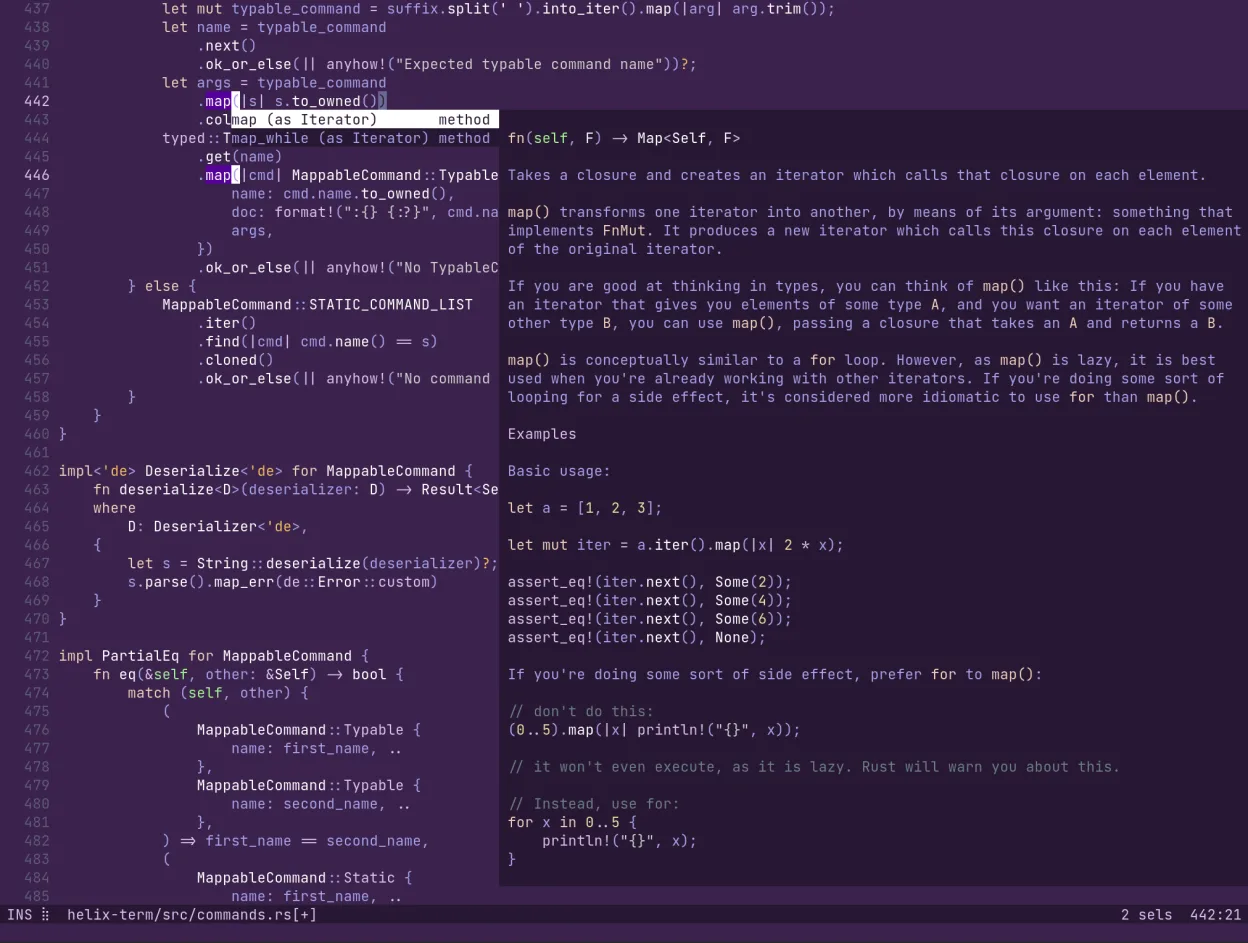
Helix is a strong alternative for Vim users who want speed and modern features without managing plugins. It handles modal editing and multiple selections well, making it ideal for developers tired of Vim's configuration overhead. However, it is not a drop-in replacement. If you rely heavily on a specific Vim plugin ecosystem or use the GUI version, you will face friction. Helix shines in terminal environments where built-in LSP and tree-sitter parsing replace many external tools. It is best suited for users prioritizing performance and simplicity over deep, legacy customization.
- License
- MPL-2.0
- Price
- Free
- Latest version
- 25.07.1 (July 18, 2025)
- Rating
- —
What works the same
- Modal editing workflow with distinct normal and insert modes
- Highly configurable keybindings via TOML files
- Efficient text manipulation commands for quick navigation and editing
- Terminal-based interface that runs on Linux
What is different
- No traditional plugin system; features like LSP are built-in
- Lacks a native GUI interface, unlike Vim's gVim or GVim
- Uses TOML for configuration instead of Vimscript
- Multiple selections are a core feature, not an add-on
- Cross-platform consistency is limited to terminal environments
Opening your Vim files
Helix opens standard text files, source code, and configuration files directly. It does not use Vim's .vimrc or .viminfo files, so you cannot simply copy your Vim configuration. However, any plain text file edited in Vim can be opened and saved in Helix without conversion. Binary files or specialized Vim buffer formats are not supported, but for typical development work, file compatibility is complete.
Switching from Vim to Helix, step by step
- Install Helix via your package manager or Flathub
- Create a ~/.config/helix/config.toml file for basic settings
- Map your most used Vim keybindings in the config if they differ
- Test opening a project to verify LSP and tree-sitter integration
- Review the built-in documentation for command differences
Key features of Helix
- Modal editing similar to Vim/Kakoune
- Built-in Language Server Protocol (LSP) support
- Tree-sitter based syntax highlighting
- Multiple cursor and selection support
- Written in Rust for performance
- No plugin system required for core features
- Terminal-based interface
- Incremental parsing for large files
How to install Helix on Linux
flatpak install flathub com.helix_editor.HelixFrequently asked questions
Can I use my existing Vim plugins in Helix?
No, Helix does not support Vim plugins. Many features like LSP, syntax highlighting, and multiple cursors are built-in, so you likely won't need the same plugins. However, highly specialized workflows may not have direct equivalents.
Does Helix have a GUI mode?
No, Helix is strictly a terminal-based editor. If you require a graphical interface, you must run it inside a terminal emulator. It does not provide a standalone GUI application like GVim.
Is Helix faster than Vim?
Helix is generally faster for startup and handling large files due to its Rust implementation and incremental parsing. Vim is also very fast, but Helix avoids the overhead of loading many plugins, which can slow down Vim's startup time.
4 other alternatives to Vim
 NeovimNeovim is a modern Vim fork that adds extensibility, advanced UI support, and powerful extensions while…Open sourceFreeFlatpakNeovim vs Vim
 GNU EmacsGNU Emacs is a highly extensible text editor and Lisp interpreter that functions as a complete development…Open sourceFreeFlatpakGNU Emacs vs Vim
 KateKate is a feature-rich, programmer-focused text editor from KDE with support for 300+ languages and advanced…Open sourceFreeFlatpakKate vs Vim
 geditgedit is GNOME's lightweight, general-purpose text editor, suitable for notes, documents, and basic code…Open sourceFreeFlatpakgedit vs Vim