
 HTTPieLinux
vs
InsomniaWindows
HTTPie as a Linux alternative to Insomnia
Updated
Our verdict
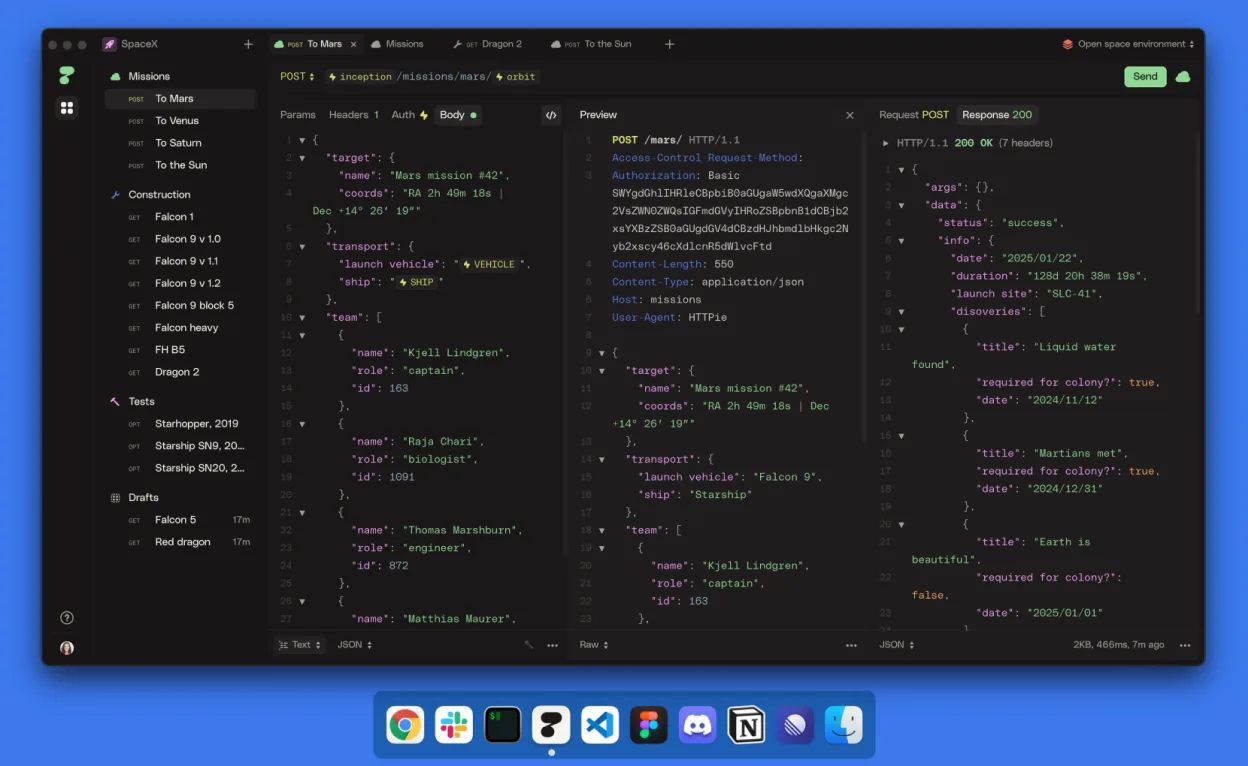
HTTPie Desktop is a solid replacement for Insomnia for developers who want a clean, intuitive GUI to test APIs without account requirements. It handles REST, GraphQL, and common auth methods like API keys and OAuth, supports environments and variables, and allows offline use. The AI-assisted request building can speed up workflows, and its organization system with spaces and collections mirrors Insomnia’s structure. However, those relying heavily on detailed documentation features or advanced debugging tools may need to adapt. Best for users prioritizing simplicity and cross-device sync without vendor lock-in.
- License
- LicenseRef-proprietary=https://httpie.io…
- Price
- Free
- Latest version
- 2025.2.0 (March 14, 2025)
- Rating
- —
What works the same
- Both support REST, GraphQL, and standard authentication methods including API keys and OAuth
- Offer environment variables and request organization via collections and tabs
- Provide offline functionality without requiring an account
- Include request history and detailed response inspection
- Allow saving, editing, and reusing HTTP requests (GET, POST, etc.)
What is different
- HTTPie Desktop includes AI-assisted request building, which Insomnia does not emphasize
- HTTPie requires a proprietary license, while Insomnia is open-source (though both are free to use)
- Insomnia has more mature API documentation features; HTTPie focuses more on testing than publishing docs
- HTTPie offers real-time sync across devices with auto-save, a feature Insomnia lacks by default
- Insomnia allows deeper plugin customization; HTTPie is more opinionated and minimal
Opening your Insomnia files
HTTPie Desktop does not officially document support for importing Insomnia collections directly. While both tools can export requests as cURL or JSON, there's no guaranteed one-click import path from Insomnia to HTTPie. Users may need to manually recreate collections or use intermediate formats like cURL for transfer. Community tools or scripts might help bridge the gap, but native file compatibility is not confirmed.
Switching from Insomnia to HTTPie, step by step
- Export your Insomnia collections as JSON or cURL from the Insomnia app
- Install HTTPie Desktop from Flathub or the official site on your Linux system
- Create a new Workspace and import requests using available formats
- Recreate environment variables and authentication profiles in HTTPie's Variables and Environments settings
- Organize imported requests into Spaces and Collections as needed
- Test a few key requests offline to verify behavior and response handling
Key features of HTTPie
- Sleek graphical interface for crafting requests
- AI‑assisted request building
- Spaces, collections, and tabs for organization
- Variables and environments for parameterisation
- Auto‑save and real‑time sync across devices
- Offline mode without an account
How to install HTTPie on Linux
flatpak install flathub io.httpie.Httpiesudo apt install httpiesudo apt install httpiesudo dnf install httpiesudo pacman -S httpiesudo zypper install httpieFrequently asked questions
Do I need an account to use HTTPie Desktop on Linux?
No. HTTPie Desktop works fully offline and does not require an account to use, sync, or save data.
Can HTTPie handle GraphQL requests like Insomnia?
Yes. HTTPie Desktop supports GraphQL queries and mutations with proper content-type and body formatting, similar to Insomnia.
Is HTTPie Desktop open-source?
No. While the original command-line HTTPie is open-source, HTTPie Desktop uses a proprietary license and is not open-source software.
3 other alternatives to Insomnia
 PostmanPostman is a cross-platform API development environment for building, testing, and collaborating on APIs.FlatpakPostman vs Insomnia
 BrunoA fast, offline-first API client that stores collections as plain text files in your filesystem for easy Git…FlatpakBruno vs InsomniacURLcURL is a command‑line tool that transfers data with URL syntax, supporting many protocols.Open sourceFreecURL vs Insomnia