
 SpyderLinux
vs
JetBrains PyCharmWindows
Spyder as a Linux alternative to JetBrains PyCharm
Updated
Our verdict
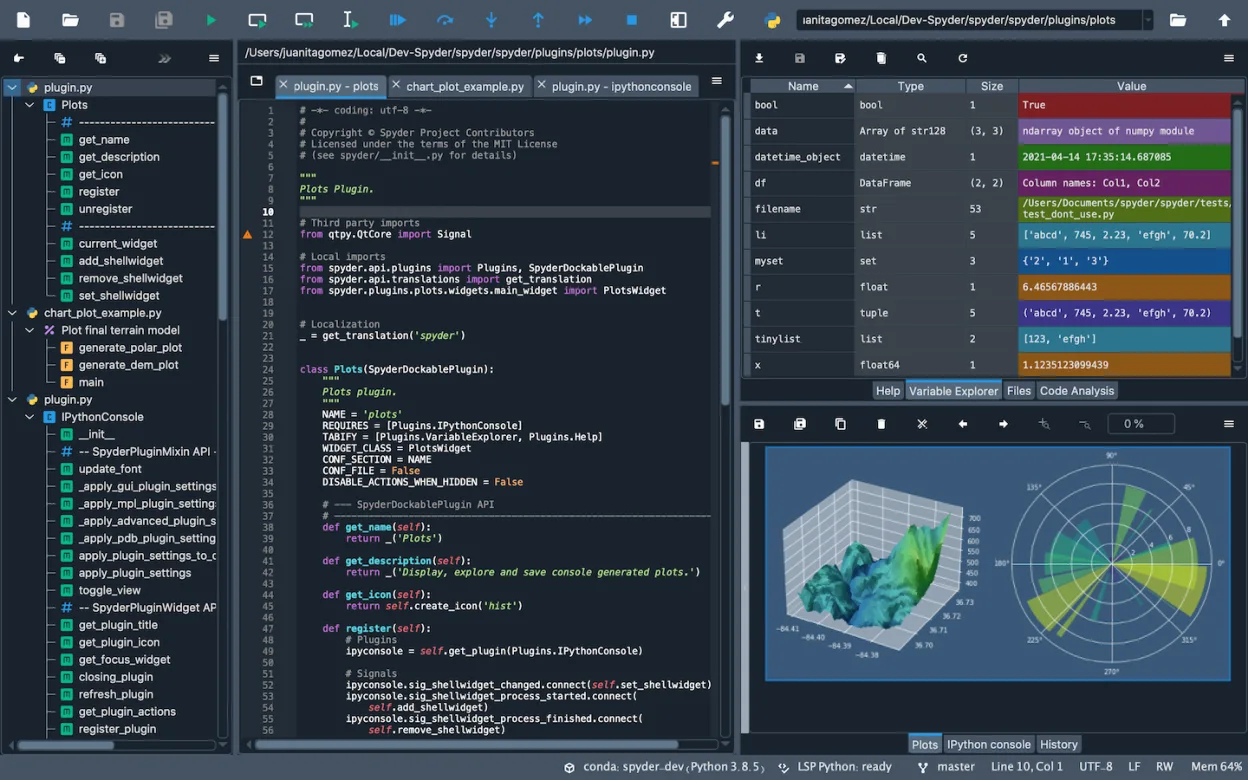
Spyder can replace PyCharm for users who focus on scientific work, data analysis, and interactive debugging. It offers solid code completion, a powerful debugger, and version‑control integration, plus a variable explorer and rich console that PyCharm lacks. However, it is not as feature‑rich for general software development: refactoring tools, advanced testing frameworks, and extensive plugin ecosystem are weaker. For researchers, data scientists, or students who need an all‑in‑one scientific IDE, Spyder is a good fit; for larger projects or teams that rely on PyCharm’s full feature set, it may fall short.
- License
- MIT
- Price
- Free
- Latest version
- v6.1.6 (July 28, 2026)
- Rating
- —
What works the same
- Python syntax highlighting and autocompletion
- Integrated graphical debugger
- Unit testing framework support (pytest, unittest)
- Version control system integration (Git, Mercurial)
- Virtual environment management
What is different
- Spyder focuses on scientific libraries; lacks advanced refactoring and code navigation features of PyCharm
- PyCharm has a richer plugin ecosystem and more mature testing UI
- Spyder’s debugging is tied to the IPython console, while PyCharm offers a more traditional IDE debugger
- PyCharm provides better support for web frameworks and multi‑language projects
- Spyder’s UI is lighter but offers less customization for complex project structures
Opening your JetBrains PyCharm files
Spyder does not open PyCharm project files (.idea). You can import Python files directly, but project settings, run configurations, and VCS mappings must be recreated manually.
Switching from JetBrains PyCharm to Spyder, step by step
- Export your virtual environment or list of packages from PyCharm (pip freeze > requirements.txt).
- Create a new Spyder project and add the same source directories.
- Install the listed packages into a new virtual environment and activate it in Spyder’s preferences.
- Re‑create VCS mappings in Spyder’s version control settings.
- Re‑implement any custom run configurations using Spyder’s run settings.
- Verify that tests run by configuring the test runner in Spyder’s preferences.
Key features of Spyder
- Interactive IPython console with rich output rendering
- Variable explorer for inspecting large NumPy arrays and Pandas DataFrames
- Integrated debugging with step-through execution and breakpoint management
- Built-in support for Matplotlib, SymPy, and SciPy visualization
- Plugin architecture for extending functionality with custom tools
- Project manager for organizing multiple files and configurations
- Code analysis and linting via Pylint and PEP8 integration
How to install Spyder on Linux
flatpak install flathub org.spyder_ide.spydersudo apt install spydersudo apt install spydersudo dnf install spydersudo pacman -S spydersudo zypper install spyderFrequently asked questions
Does Spyder support virtual environments?
Yes, Spyder can use any Python interpreter, including virtual environments created with venv, conda, or virtualenv. Set the interpreter in Preferences → Python interpreter.
Can I use Spyder for non‑scientific projects?
Spyder works fine for general Python development, but it lacks some advanced refactoring and multi‑language features that PyCharm offers. It’s suitable for small to medium projects.
Is Spyder free for commercial use?
Spyder is released under the MIT license, so it can be used freely in commercial environments without licensing fees.
5 other alternatives to JetBrains PyCharm
 Visual Studio CodeA lightweight, extensible code editor that supports debugging, Git, and many languages.FreeFlatpakVisual Studio Code vs JetBrains PyCharm
 ThonnyThonny is a lightweight, beginner‑focused Python IDE with an integrated visual debugger and simple package…Open sourceFreeFlatpakThonny vs JetBrains PyCharm
 GeanyGeany is a lightweight, fast IDE that supports many languages and plugins out of the box.Open sourceFreeFlatpakGeany vs JetBrains PyCharm
 KateKate is a feature-rich, programmer-focused text editor from KDE with support for 300+ languages and advanced…Open sourceFreeFlatpakKate vs JetBrains PyCharm
 VimVim is a highly configurable, modal text editor for efficient editing on Linux.Open sourceFreeFlatpakVim vs JetBrains PyCharm