
 PiTiViLinux
vs
CapCut (Windows)Windows
PiTiVi as a Linux alternative to CapCut (Windows)
Updated
Our verdict
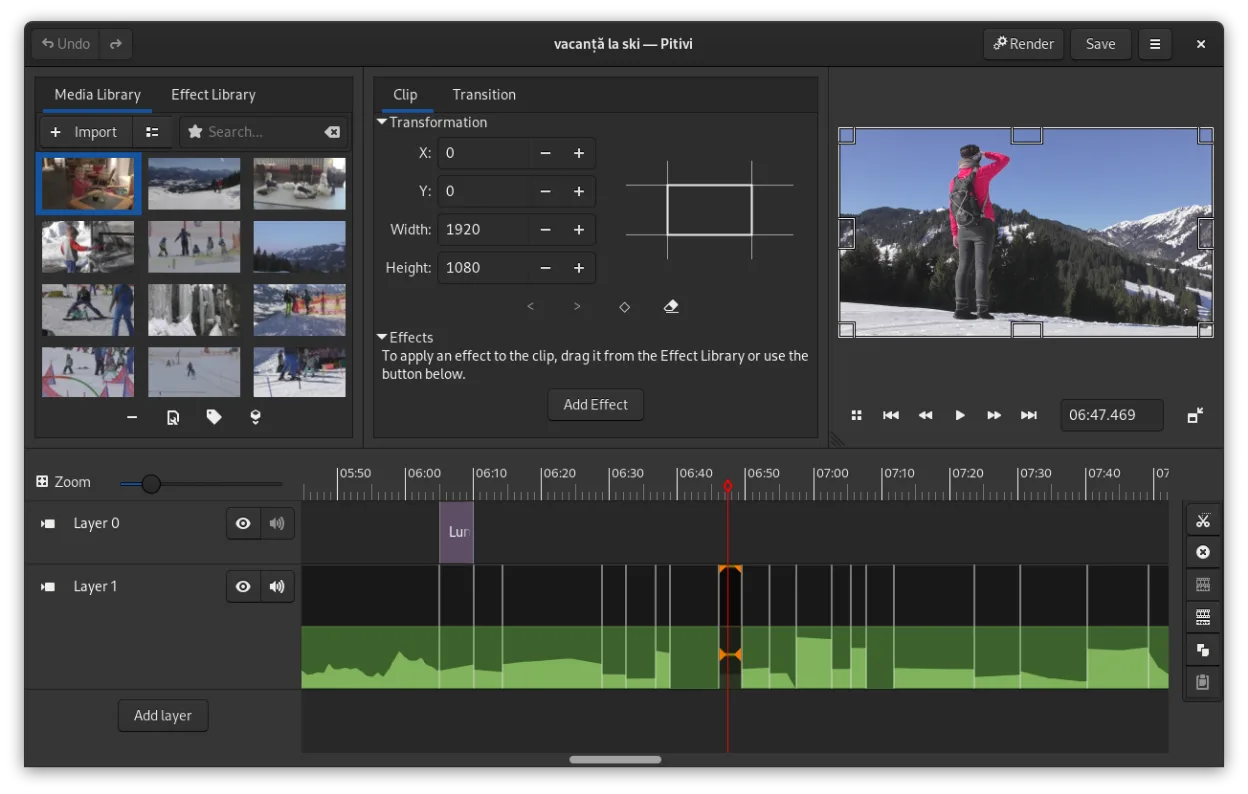
PiTiVi can serve as a viable Linux replacement for CapCut, especially for users who need a traditional non‑linear editor rather than a mobile‑style quick‑cut tool. It offers a full timeline, keyframe animation, and a decent set of transitions, making it suitable for hobbyists and semi‑professional creators who work on social‑media clips. It lacks the huge library of ready‑made effects and the ultra‑fast workflow that CapCut markets, so power users who rely on those shortcuts may find it slower, but anyone comfortable with a desktop NLE will be able to produce comparable results.
- License
- LGPL-2.0+
- Price
- Free
- Latest version
- 2023.03 (March 26, 2023)
- Rating
- —
What works the same
- Non‑linear timeline editing
- Support for common video formats via GStreamer (MP4, MOV, MKV, etc.)
- Basic audio mixing and volume keyframes
- Text overlay / title tracks
- Export presets for common resolutions
What is different
- CapCut includes a large collection of pre‑made visual effects and stickers; PiTiVi relies on manual filters and keyframes
- CapCut’s UI is optimized for quick, mobile‑style cuts; PiTiVi follows a desktop GNOME workflow with detachable panels
- CapCut provides built‑in social‑media export presets (TikTok, Instagram); PiTiVi requires manual setting of resolution/bitrate
- CapCut offers AI‑assisted features (auto‑caption, background removal) that PiTiVi does not have
Opening your CapCut (Windows) files
PiTiVi can open any format that GStreamer can decode, which includes the MP4, MOV and MKV files typically produced by CapCut. Exporting back to a CapCut‑compatible file is straightforward: choose MP4 with H.264 video and AAC audio. If you need a specific CapCut project file (.capcut), PiTiVi cannot read that proprietary format, so you must export a standard video first.
Switching from CapCut (Windows) to PiTiVi, step by step
- Install PiTiVi from your distro’s repository or via Flathub.
- Export your finished CapCut project as an MP4 (or another common format).
- Open the exported file in PiTiVi and verify audio/video sync.
- Re‑create any text overlays or effects using PiTiVi’s title and filter tools.
- Set the output resolution and bitrate to match your target social‑media platform.
- Export the final video and, if needed, upload it to the same platforms you used with CapCut.
Key features of PiTiVi
- Non-linear editing with a framerate-independent timeline
- Supports any format handled by GStreamer
- Keyframe animation for effects and filters
- Ripple and roll editing for efficient timeline adjustments
- Custom aspect ratios, framerates, and render presets
- Crossfades and SMPTE-standard transitions
- Detachable UI panels for multi-monitor setups
- Non-modal editing workflow with playhead-centric design
How to install PiTiVi on Linux
flatpak install flathub org.pitivi.Pitivisudo apt install pitivisudo apt install pitivisudo dnf install pitivisudo pacman -S pitivisudo zypper install pitiviFrequently asked questions
Can PiTiVi import CapCut project files directly?
No. PiTiVi only works with standard media files; you must export from CapCut first.
Is there a built‑in library of stickers and memes like in CapCut?
PiTiVi does not include a curated sticker library; you would need to import images or use external assets.
Does PiTiVi support GPU‑accelerated rendering?
Rendering relies on GStreamer plugins; hardware acceleration is available if the appropriate plugins (e.g., vaapi) are installed, but it is not as automatic as CapCut’s built‑in GPU support.
5 other alternatives to CapCut (Windows)
 KdenliveKdenlive is a free, feature‑rich non‑linear video editor built on the MLT framework.Open sourceFreeFlatpakKdenlive vs CapCut (Windows)
 ShotcutShotcut is a free, open-source video editor for Linux with support for a wide range of formats via FFmpeg.Open sourceFreeFlatpakShotcut vs CapCut (Windows)
 OliveOlive is a free, open‑source non‑linear video editor for Linux.Open sourceFreeFlatpakOlive vs CapCut (Windows)
 OpenShotOpenShot is a free, open-source, non-linear video editor for Linux and other platforms, built with Python and…Open sourceFreeFlatpakOpenShot vs CapCut (Windows)
 FlowbladeFlowblade is a fast, stable, multitrack non-linear video editor for Linux, suitable for beginners to…Open sourceFreeFlatpakFlowblade vs CapCut (Windows)